Bengal juggles peace, protest - Singur clash kicks off see-saw week | |
| OUR SPECIAL CORRESPONDENT | |
Calcutta, May 20: Welcome to the politics of peace and protest, Bengal-style. Violence flared up in Singur as well as Nandigram today, less than 24 hours after a breakthrough that put Bengal’s principal political opponents on course to a peace meeting. In Singur, the confrontation went a notch beyond the usual cat-and-mouse game after a knife attack on police during a Trinamul Congress-led attempt to tear down a portion of the wall around the Tata small-car project. Rubber bullets and tear gas shells were fired, injuring some but none grievously, according to officials. The clashes, however, did emit enough smoke and fire — and television footage — to rustle up what Mamata Banerjee candidly described as her “daily meal”. Mamata declared that there would be no let-up in the agitation in both Singur and Nandigram but took care to point out that she stood by her commitment to the all-party meeting scheduled for Thursday. “How can one expect me to stop taking my regular meals at home just because I got a dinner invitation for a day? Movements would go on in Haldia, Singur and Nandigram, along with the peace process,” she said. “We are committed to the peace process but the government should prove its sincerity. It is hell bent on crushing the Opposition.” Today’s flare-up is being seen as an attempt by Trinamul to reassure its supporters — the party holds sway in Singur — that their cause has not been sacrificed at the altar of the peace initiative. Mamata is making a clear distinction between the all-party meeting and other programmes: the peace bid is a purely humanitarian issue that will allow the displaced (CPM supporters) to return to their homes in Nandigram. Perhaps trying to send a message that consent to the meeting should not be confused with compliance on other issues, a group suspected to be linked to Trinamul ransacked houses of some CPM supporters in Nandigram. Mamata suggested that the pot would be kept boiling before and after the peace meeting. (See chart) The CPM, equally eager not to be seen as going soft on its sworn enemy, has lined up its own version of peace-cum-protest. The party has urged cadres to organise marches and meetings across the state on Tuesday to protest against the violence in Singur. If Mamata served up a culinary analogy, so did CPM veteran Benoy Konar. “She is a carnivore who has been requested to eat grass, which she will do only under compulsion,” he said, referring to Mamata’s willingness to attend the all-party meeting. Keen to ensure that the peace process stays on track, Left Front negotiator Ashok Ghosh urged both sides to ensure “an atmosphere conductive to the meeting”. Ghosh tonight went to Jyoti Basu’s home to request him to attend the peace meeting “at least for a while” as Nandigram has become “a national and international issue”. Citing poor health, Basu has not yet given a commitment. Chief minister Buddhadeb Bhattacharjee, too, struck a conciliatory note. “My hair has turned grey and my health is failing. I cannot do everything alone if you don’t cooperate,” he told a Nadia gathering that included Congress, Trinamul and BJP members. | |
 |
Monday, May 21, 2007


Govt gears up for big push to broadband | ||
| OUR CORRESPONDENT | ||
New Delhi, May 20: The government is planning to let broadband operators use the network of telecom PSUs to reach households. It will also release additional spectrum for the service. Using the network of BSNL and MTNL will help solve the last mile problem. The last mile, in industry parlance, is the final leg of delivering connectivity. It involves laying of wires and cables, which is an expensive exercise and takes considerable physical effort. Since the PSUs already have such a network in place, the broadband operators will benefit if they are allowed access to this infrastructure. A telecom ministry officials said the new minister A. Raja would again take a look at the recommendations of the Telecom Regulatory Authority of India (Trai) on the last mile. Trai had supported the last mile principle to promote broadband, but the proposal was rejected by previous incumbent Dayanidhi Maran “in order to protect BSNL,” the official said. “Even though the vast copper wire and optic fibre network is well spread and expansive in the country, it remains underutilised,” the official added. The government will also release additional spectrum to facilitate WiMax, which is a form of wireless broadband. A DoT report says there are problems of frequency in some of the key bands, such as 2.3-2.4 GHz and 2.5 GHz. Analysts said operators would have to wait for a long period before they can launch WiMax. WiMAX, an acronym that stands for Worldwide Interoperability for Microwave Access, is a technology for broadband and 3G services over wireless networks at a low cost. WiMax provides high-speed wireless connectivity and is simpler and cheaper than other mobile technologies. The technology can be used for the remote rural regions. Trai is working on a WiMax policy. Telecom players such as Reliance Communications, Bharti, Tata Telecom, BSNL and MTNL are all set to roll out the service in a phased manner as soon as they get the permission from the government. Though it is more efficient than the traditional dial-up system of connecting to the Internet, broadband penetration in India is low compared with other countries. Only 2.5 per cent of Indian homes has broadband. The figure for China is 14 per cent and Brazil 9 per cent. In Thailand, 3 per cent of the homes has broadband. |

Wednesday, May 16, 2007
Sunday, October 22, 2006


Fifth-grader Kevin Chen studies math in his living room in Alameda every week with his tutor, Syeda Nikath Sumaiya -- who works from her home in Seoul.
In the latest incarnation of outsourcing, overseas tutors are teaching U.S. students math, science, English and social studies. And parents are paying half as much as they would for face-to-face instruction.
Via Internet phone, Sumaiya, 27, who works for a Bangalore company, coached the 11-year-old through drills and word problems in her clipped British Indian accent one recent evening. The equations she drew in red materialized on Kevin's screen in Alameda, and he wrote back in blue.
"I think you're carrying twice sometimes," said Sumaiya, an engineer from Bangalore, India, before she moved to South Korea for her husband's job. "Just do it once."
Sumaiya, who communicated with The Chronicle by e-mail, drew a red arrow to point out Kevin's errors, asking aloud, "Do you follow?" and rewarding him with, "That's right," and a big check for a correct answer.
At least a half-dozen tutoring companies operate from India, including two with Bay Area ties: Growing Stars is headquartered in Santa Clara, and TutorVista in Bangalore received $11 million in venture funding from Menlo Park's Sequoia Capital this year.
Online tutoring, which began in the late 1990s, has grown in the past five years, education analysts say, as communication technology improved and became more affordable. It accounts for about 6 percent of the $2.2 billion U.S. private tutoring market, which reached 1.9 million K-12 students last school year, according to Tim Wiley, senior analyst at Eduventures, an education and research consulting firm in Boston.
"You encounter the same natural incentives as manufacturing did in the 1980s, moving factories offshore to lower-priced markets, and what the white-collar sector is going through now," Wiley said. "The dynamics are in place for India-based tutoring companies to really grab a big chunk of the online market."
Between $20 million and $25 million of the roughly $132 million spent on online tutoring -- or one-sixth -- now goes to tutors in India, Wiley said. But Indian tutors may make up an even larger share of online tutors because they are paid much less than their U.S. counterparts.
TutorVista pays its employees $300 per month, and Growing Stars pays $350 to $450 per month, for roughly a 40-hour workweek. That's a lower-middle-income salary, said Ashok Bardhan, a senior economist at UC Berkeley's Haas School of Business. By comparison, in-home tutors in the United States charge $40 to $60 an hour.
Growing Stars, which began offering tutoring in 2004, serves 400 students who pay $21 to $25 per hour. TutorVista, which started in November 2005 and charges $20 for a 45-minute session or $100 a month for unlimited hours, has 2,000 students and aims to reach 5,000 by next fall.
Sanjo Mathew, 25, has tutored with Growing Stars for a year.
"You don't see the students, so you must listen to them. Some of them don't speak for two to three months. You have to make those children interact," said Mathew, who has a master's degree in biology. "Tutoring takes a lot of time and patience."
But tutors are common in India, said Growing Stars founder Biju Mathew (no relation to tutor Sanjo), who moved to the Bay Area from India in 2000 as a software programmer and founded his startup two years later.
"The idea seemed good for me as a parent, and I thought there would be thousands of other parents for whom this could be of use," said Biju Mathew, who had sought affordable tutoring for his three sons.
So far, industry leaders such as Kumon and Score do not offer online tutoring, because they run centers and their value lies in their face-to-face interaction, company officials and analysts say. Sylvan offers it only with instructors from the United States, to control quality, said spokeswoman Wendy Odell Magus.
Officials at tutoring companies that hire abroad say they check tutors' references and academic backgrounds -- Growing Stars and TutorVista require tutors to have a master's degree in the primary subject matter they teach. The one-on-one attention they offer is more effective, they say. The companies train the tutors for a couple weeks, review their performance, and solicit feedback from parents.
At Growing Stars and TutorVista, tutors receive training in accent reduction and American culture -- including the rules of baseball, and popular movies and music. And TutorVista will switch tutors until the student feels comfortable, said Patricia Perry, vice president of marketing. She said the average TutorVista instructor has 10 years of teaching experience, more than any state requires for in-school tutors. TutorVista's employees tend to work from home, while instructors at Growing Stars work from its teaching center in Cochin, on the coast in southwest India. They start as early as 1:30 a.m. at Growing Stars and 4:30 a.m. at TutorVista in India.
Kevin's mother, Biyu Lin Chen, 33, who emigrated from China in 1997, said she wants her son and twin daughters to have a good education. Now a child care provider, she prefers TutorVista to the traditional tutor her children saw for a couple months because TutorVista is cheaper and more convenient. And she said Kevin is getting better scores on his math tests, after only a few weeks.
Kevin said he feels more comfortable talking to his tutor -- sight unseen -- than asking questions in class: "No one is paying attention to me that much."
Some parents sign up their children with online tutors to give the students an edge. Even though Raj and Rati Sardesh's daughter Nina, for example, had skipped a grade and was doing well in the sixth grade at the French American School in San Francisco, they signed her up for Growing Stars tutoring in math and science.
"Some other parents laughed at us since we spend money for a private school," said Rati Sardesh, an ultrasound technician.
Despite disliking the extra work, Nina, 11, said the tutoring boosted her marks.
"I really like my tutors. We're friends and have student-teacher status," she said. "It's almost like they're there teaching you, when you close your eyes."
Online tutors also help answer the endless "why" questions of a curious child.
Isha Gulati, 8, of San Jose connects with her TutorVista instructor four or five times a week and asks her about math, science, geography and English.
"It's really fun," Isha said. "We always talk about things I really want to know."
Her tutor, Bina Joseph, 36, has worked for TutorVista for about six months, logging on from her home in Bangalore, she said by e-mail. The job gives her time to raise her family, said Joseph, who has a master's degree in English and bachelor's degrees in science and education.
Isha's mother, Charu Gulati, is a middle school science teacher who sees the benefits of both educational systems: the rigors of India and the creativity encouraged in the United States.
"She loves to know about more stuff. But I don't always have the answers or the time to answer."
Tuesday, May 15, 2007

Sunday, May 13, 2007
The inspiring story of Suresh Kamath
Shobha Warrier | May 10, 2007
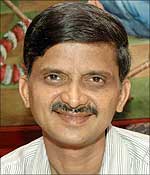 Suresh Kamath, managing director, Laser Soft Infosystems Ltd | ||


Suresh Kamath, the managing director of Chennai based Laser Soft Infosystems Ltd is an unusual man. Unlike most other entrepreneurs, he does not aspire to create a business empire; his sole ambition is to provide employment to 10,000 people. He also plans to reserve 40 per cent of the jobs for the disabled.
Suresh started Laser Soft in 1986 with just Rs 200 and five people. Today, the company is a force to reckon with in the banking software arena.
In recognition of his commitment to the disabled, President of India A P J Abdul Kalam felicitated Suresh with the Best Employer award in December 2005. He also won the Best Employer award from the Tamil Nadu government. He has been awarded the NCPEDP shell Helen Keller Award for giving equal rights and gainful employment to persons with disabilities.
Read on for the inspiring story of Suresh Kamath
Ambition as a child
I come from a poor family. We lived in a one-room-kitchen house in Mysore. Though my father struggled very hard, he did not let his penury affect the lives of his children. Unemployment, depravation, hardship pained me and right from my school days my ambition was to create employment in this country. As a child I was motivated by Mr Laxman Rao - one of my teachers at school who always advised me to do something for the country.
I heard tales of poverty and struggle from my father and grandmother. How my father could study only up to the 10th standard, as he did not have money for further education. My mother too did her schooling only till the 8th standard. But all this hardship did not stop them from encouraging us to continue with our studies. I was the eldest among my siblings and took up the mantle of setting an example. Encouraged by my performance - I was always a rank holder - my younger siblings too did very well in studies.
As far as my career was concerned, my father gave me full freedom and I decided to study engineering. I joined the National Institute of Engineering in Mysore in 1975 in electronics and then did my M Tech in computer science from the Indian Institute of Technology, Madras.
Life after graduation
I was keen to start my own company immediately after my post graduation. But since I did not have any job experience I was advised against any such move. So, I joined Tata Consultancy Services and worked for a year. I noticed that all the major Indian software companies were into services; they were not into creating products and it disappointed me. I was convinced that India could create excellent products thanks to the huge talent pool available here.
While at TCS I found that most of my colleagues aspired to go abroad to further their career. But I was not interested in overseas assignments.
Even at IIT, I was the only student in our batch of 20 who did not go abroad after studies. On hearing of my ambition, many of my friends ridiculed me and even called me a 'fool'! I took their scorn in my stride. However, my parents were very supportive. They encouraged me not to pay heed to what others were saying and encouraged me to strive to give shape to my ambition.
After TCS, I joined another company that was into hardware because I wanted some related experience. I worked there for three years.
Starting Laser Soft
When I was 28, my father told me to get married. I decided to marry the girl of his choice. By then I had decided to quit my job and start my own company. I told my fiancee of my plans and asked her if she still wanted to marry me. She said, 'Yes. I have faith in you.'
On May 1, 1986 I launched my company. I intentionally chose May Day as it is also labours' day.
With initial capital of Rs 200 and five technical people from NIIT the company was launched. I told them, 'I will give you whatever I can afford but all of us will draw the same salary.' I did not even try to hire any engineers, as I was convinced that they won't work for a small company like mine. Also, I strongly believe that you don't need engineers for programming. What you need is logic. I also wanted a team that would be the foundation of the company, who would remain with the company.
Why Laser Soft? Because the word laser - meaning accuracy and precision - appealed to me, and soft is of course from software. Our office was a room in my house, and our first job was to get visiting cards and letterheads printed.
First client
We decided to focus on banking and healthcare. Banking because it was a gargantuan sector and had huge potential. At that time automation of the banking system was a faraway dream. We approached the State Bank of India and Apollo Hospitals and told how our products could facilitate their work. SBI admitted that they had a six-month backlog in the DD purchase for Madras Fertiliser Ltd. Since we did not have computers, we requested SBI to allow us to work in the bank in the evening. They agreed.
First product
Our product for SBI was out in two weeks' time and the backlog was cleared within a month. Our first product was thus a big success. Both SBI and MFL were very happy and we were paid a remuneration of Rs 5,000.
Sensing that we could help them in various quarters, SBI sent us to their overseas branch -- which incidentally was their largest branch in the South doing business of over Rs 5000 crores. Everything was done manually. On any given day the branch could take only 25 bills from the exporters. Our product, readied in a week's time, was exclusively for handling export bills.
From 25 bills, they were able to handle 200 bills a day and the profit of the branch zoomed to Rs 55 crores (Rs 550 million).
End of first year
By the end of the first year, our turnover was Rs 128,000, and our staff strength had doubled to 10. With Rs 1000 as monthly salary, we could manage. After the success of the export bills, SBI assigned more work to us. As our work pressure increased, we hired more people and by the end of the second year we were 25 people and our profit stood at a handsome Rs 600,000. In five years' time, we computerised 70 SBI branches all over India.
Parthasarathy
Then one morning in 1987 Parthasarathy - we call him Partha - came to meet me. He was disabled and was not an engineer but had undergone a computer course that the government had offered in an institute. I told Partha, "I like to employ people like you."
And it was not a wrong decision. Partha had an amazing zeal and his disability did not stop him from being mobile. I thought it was the right model for any industry to follow.
I was not doing any charity by employing him because my company benefited more from Partha than vice-versa. I have noticed that physically challenged people are more committed than others but unfortunately we pay scant attention to them. Business houses talk about attrition. I tell them, 'Look at these people, they will never leave you.'
Disabled-friendly office
At that time our office was in the first floor and Partah had difficulty tackling the stairs. Seeing him struggle, I decided to make the entire office disabled-friendly. Our ground floor is now exclusively for the disabled people, and we have ramps in our office and there are special toilets for them too. We have also built houses for them near the office so that they can avoid long travelling hours.
After meeting Partha, I decided to hire more disabled people. We waited six months to get a disabled person who could be our receptionist.
Reservation
I don't look at employing disabled people as charity. I look at this as my responsibility. This country has spent money to educate me and I feel it is my duty to do something for the less privileged.
It had been a great experience working with them. Seeing them work, get married, settle in life and have children is a wonderful experience.
We have 550 employees now, and 15 per cent of them are disabled. We go to engineering colleges looking for disabled people but find only one or two in each college. Parents don't send them out. The biggest challenge for the physically handicapped is the attitude of their parents. We, at LaserSoft, hire them even if they are not engineers.
Other than the physically challenged, we have people suffering from cerebral palsy too working for us. We find them good in graphics. Many of our employees are deaf and dumb.
Best employer award
I was elated when I won the award but with all humility, let me say I am doing very little. I am very disappointed to see that I was chosen when there are so many business giants in India. Seven per cent of India's population is disabled but all of us turn a blind eye to them. I realised that if I could get an award by doing so little, it means that others are not doing even this much.
I was honoured to meet Dr Abdul Kalam. He is a wonderful person, a real motivator. He asked me, 'What exactly do the disabled people do in the company? Do they do software or menial job?' I told him barring two all are involved with technology.
Ambition
My ambition is to create 10,000 jobs, and I want to reserve 40 per cent of that for the disabled. We also have a light top model as far as salaries are concerned. We don't give huge salaries to those who occupy the top positions but distribute the money to all the employees.
Reservation row
Reservation based on caste is going to divide us further. Reservation should be based on economic criteria alone. We should learn to forget our past and start looking at the future. What have today's children got to do with what some people did in the past?
What difference does it make if you are a brahmin or a non-brahmin when you are poor? How many IITs and IIMs do we have? How many good medical colleges and engineering colleges do we have? We have such a vast population but not enough resources. Instead of starting more colleges, and there should be special colleges for the disabled, the government is talking about more and more reservation.
Thursday, May 10, 2007
"Exercise can make people smarter
March 19, 2007 11:35 IST"
A recent and rapidly growing movement in science is showing that exercise can make people smarter, Newsweek magazine reports in its upcoming issue.
Last week, in a landmark paper, researchers announced that they had coaxed the human brain into growing new nerve cells, a process that for decades had been thought impossible, simply by putting subjects on a three-month aerobic-workout regimen.
Other scientists, the magazine reports, have found that vigorous exercise can cause older nerve cells to form dense, interconnected webs that make the brain run faster and more efficiently. And there are clues that physical activity can stave off the beginnings of Alzheimer's disease, ADHD and other cognitive disorders.
The magazine says it examined with Harvard Medical School, the latest research and findings about how an active body is crucial for building a strong, active mind. "People have been slow to grasp that exercise can really affect cognition," says University of Illinois neuroscientist Charles Hillman.
Armed with brain-scanning tools and a sophisticated understanding of biochemistry, Newsweek reports, researchers are realising that the mental effects of exercise are far more profound and complex than they once thought.
Researchers, the article says, are learning more about how exercise affects mood: it decreases anxiety, improves sleep, improves resilience in the face of stress and raises self-esteem. All these benefits don't come because you notice what you've lost around your waist. Rather, they come from exercise-induced alterations inside your head, Michael Craig Miller, editor in chief of the Harvard Mental Health Letter, is quoted as saying.
If you are a couch potato, you have couch-potato tendencies. There are more opportunities to exercise than many people realise, the magazine says, adding find the time with exercise snacks that last as little as 10 minutes at a time.
Examples are pacing in your office while you're on the phone, taking the stairs instead of the elevator, trekking up the stairs at home during a TV commercial break. Or break up the day with two-minute walks -- to the mailbox, for example, or in a loop around your office corridor.
The magazine says that while moderate exercise is good for you, vigorous exercise is even better. Specifically, it's more effective at lowering blood pressure, improving insulin sensitivity (which can reduce the risk of developing diabetes) and raising one's aerobic capacity.
And one way to stick to a high-intensity routine is to participate in a competitive sport. Not only is it fun, but you have an obligation to show up for practices and events, the report notes.
Reams of research, it says, suggest that exercise -- an activity as old as the human race -- substantially reduces the odds of ever getting breast cancer, lengthens survival and considerably enhances quality of life for women with the disease.
Scientists don't completely understand why exercise is so important, but they're actively looking for answers, it adds.Modi's office asked officers not to probe Khan's death: Report
May 09, 2007 22:56 IST
| Related Articles | |
| • Congress sees conspiracy to kill Vanzara |
A sting operation by Aaj Tak television news channel and the news portal Tehelka claimed on Wednesday that Gujarat Chief Minister Narendra Modi had instructed senior IPS officers not to probe the alleged fake encounter of Samir Khan by tainted police officer D G Vanzara.
"The encounter of Samir Khan in 2002 -- the first in the string of encounters of so called 'terrorists' in Gujarat -- was not only stage-managed, the then principal secretary to Chief Minister Narendra Modi, P K Mishra got the inquiry papers replaced and instructed senior IPS officers not to probe the encounter since Vanzara had carried out the killing in public interest," the channel claimed in a statement.
It said Tirath Raj, the then Inspector General, Human Rights, had submitted a 20-page report to the Gujarat government indicting the CMO, the then DGP K Chakraborty, then Ahmedabad Joint Commissioner of Police (crime) P P Pandey and Vanzara for 'fabricating documents and hushing up the inquiry'.
"These officers were called to the CMO. The CM's secretary PK Mishra said that they (Vanzara and others) had acted in public interest. He instructed Chitaranjan Singh (then acting Ahmedabad Commissioner of Police) to destroy the papers," Raj told undercover journalists, the statement claimed.
The statement alleged Vanzara had made a phone call to Raj and threatened to kill him if he did not stop inquirng into the matter.
